Reviewed by Mimi Rankin
 DESCRIPTION OF THE BOOK: Marcus Vega is six feet tall, 180 pounds, and the owner of a premature mustache. When you look like this and you’re only in the eighth grade, you’re both a threat and a target.
After a fight at school leaves Marcus facing suspension, Marcus’s mom decides it’s time for a change of environment. She takes Marcus and his younger brother to Puerto Rico to spend a week with relative they don’t remember or have never met. But Marcus can’t focus knowing that his father— who walked out of their lives ten years ago—is somewhere on the island.
So begins Marcus’s incredible journey, a series of misadventures that take him all over Puerto Rico in search of his elusive namesake. Marcus doesn’t know if he’ll ever find his father, but what he ultimately discovers changes his life. And he even learns a bit of Spanish along the way.
MY TWO CENTS: What immediately drew me to this book was the title. So much discussion of “Latinx Children’s Literature” centers around bilingualism or dual-language published titles, but this title adds a very compelling commentary to those claims. Marcus Vega is 14 years old, 180 pounds, and six feet tall. This stellar combination makes some kids fear him and some taunt him. When he is nearly suspended after a fight in which he was defending his younger brother, Charlie, who has Down Syndrome, Marcus’s mom agrees that going to Puerto Rico, where the boys were born and where Marcus’s estranged dad allegedly still lives, for spring break may be just what the family needs. Suddenly embraced by a family he never knew he had, Marcus begins to learn that you can get to know yourself by knowing where you’re from.
Written in the first-person perspective of Marcus, the writing felt occasionally flat, however I’ve never been a 14-year-old boy, so I can’t authentically comment on the voice. Although I felt some parts of the plot were a bit hurried, I found myself bawling on an airplane as I finished this book. I so wholly connected with Marcus and his feeling of wondering if “where” he’s from determines who he is. Cartaya explores Latinx identity in a way that may not be recognizable to many children identifying as Latinx in some capacity. However, it was certainly a familiar feeling to this reviewer. Between not growing up speaking Spanish (only hearing it consistently at my maternal grandparents’ home) and being slapped with a Scottish surname, I was never confident in defining my being “Puerto Rican.” In reading Cartaya’s novel, I no longer felt that imposter syndrome of identifying as a Hispanic woman because I’m not terribly fluent in Spanish. Identity politics are a complicated matter and Cartaya beautifully explores a side of Latinx identity through the eyes of a young boy who has been abandoned by his connection to his Puerto Rican identity.
Cartaya introduces readers to life in Puerto Rico as Marcus is introduced to it. Arriving in Old San Juan, Marcus meets uncles and cousins he had never heard of, let alone remembered, from his very early childhood living in Puerto Rico. He is welcomed unquestionably and unconditionally. The extended family ventures to more rural areas of the island, seemingly all in search of Marcus and Charlie’s father. An interesting approach to this story was the character of Marcus’s mom, Melissa. Melissa, who is not claimed as Puerto Rican herself, spent a significant amount of time in Puerto Rico when she was younger and this is where she met her sons’ father. Melissa is revealed to be fluent in Spanish and has a close relationship with her ex-husband’s family, despite not having spoken to them in years. The character of Melissa could present some interesting conversations on the “adoption” of culture and language, and I would be interested in discussing this further. Tackling everything from bullying, economic prejudice, cultural identity theory, separated parents, parental abandonment, and coming of age, this book needs to be a cornerstone of MG literature, particularly in the #ownvoices world.
 ABOUT THE AUTHOR: Pablo Cartaya is an award-winning author whose books have been reviewed by The New York Times, featured in The Washington Post, received starred reviews from Kirkus, Booklist, Publisher’s Weekly, and School Library Journal, as well as been among the Best Books of the Year for Amazon, Chicago Public Library, NYPL, and several state award lists. He Is the author of the critically acclaimed middle grade novels The Epic Fail of Arturo Zamora (a 2018 Pura Belpré Honor Book) and Marcus Vega Doesn’t Speak Spanish. His next novel, Each Tiny Spark will debut on the new Kokila Penguin/Random House Imprint, which focuses on publishing diverse books for children and young adults. He teaches at Sierra Nevada College’s MFA program in Writing and visits schools and colleges around the country. Pablo is proudly bilingual en español y ingles. @phcartaya
 ABOUT THE REVIEWER: Mimi Rankin received her Master’s Degree with distinction in Children’s Literature from the University of Reading. Her thesis, on which she received a rating of First, centered around claims to cultural authenticity and representation in Hispanic Children’s Literature. She currently works in the publishing industry as a marketing manager for over 20 international children’s publishers. Her reviews do not reflect the opinions of her employer or clients. She currently lives in Nashville, Tennessee.
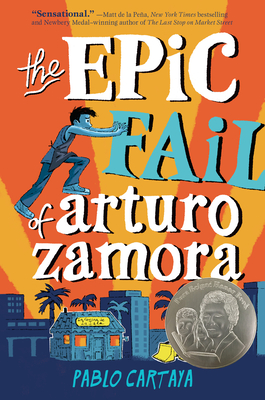 DESCRIPTION OF THE BOOK: Save the restaurant. Save the town. Get the girl. Make Abuela proud. Can thirteen-year-old Arturo Zamora do it all or is he in for a BIG, EPIC FAIL? For Arturo, summertime in Miami means playing basketball until dark, sipping mango smoothies, and keeping cool under banyan trees. And maybe a few shifts as junior lunchtime dishwasher at Abuela’s restaurant. Maybe. But this summer also includes Carmen, a poetry enthusiast who moves into Arturo’s apartment complex and turns his stomach into a deep fryer. He almost doesn’t notice the smarmy land developer who rolls into town and threatens to change it. Arturo refuses to let his family and community go down without a fight, and as he schemes with Carmen, Arturo discovers the power of poetry and protest through untold family stories and the work of José Martí.
 ABOUT THE AUTHOR: Pablo Cartaya is the author of the acclaimed middle-grade novel, The Epic Fail of Arturo Zamora (Viking, 2017); Marcus Vega Doesn’t Speak Spanish (Viking, 2018); and two forthcoming titles in 2019 and 2020 also to be published by Viking. He is a Publisher’s Weekly “Flying Start” and has received starred reviews from Kirkus, Booklist, and Publisher’s Weekly. For his performance recording the audiobook of his novel, Pablo received an Earphone Award from Audiofile Magazine and a Publisher’s Weekly Audiobooks starred review. He is the co-author of the picture book, Tina Cocolina: Queen of the Cupcakes (Random House, 2010), a contributor to the literary magazine, Miami Rail; the Spanish language editorial, Suburbano Ediciones; and a translator for the poetry chapbook, Cinco Poemas/Five Poems based on the work of poet Hyam Plutzik. Pablo visits schools and universities throughout the US and currently serves as faculty at Sierra Nevada College’s MFA in Creative Writing.
  Q. Who or what inspired you to become a writer?
 Cindy L. Rodriguez
 Latinxs in Kid Lit