By Cecilia Cackley
This interview has been condensed and edited for clarity.
Cecilia Cackley: This is your twenty-first picture book! You’ve written three of them yourself, but you’ve also worked with a wide range of collaborators. How do you feel like your process has evolved as an artist?
Lauren Castillo: It feels like I’m choosing a different medium for each project, but somehow it ends up looking like the same type of art to others. Imagine for instance, doesn’t look too different from Nana in the City, but to me, I definitely worked in a lot of different ways to make the art. For example, because this book had so many landscapes, I really wanted to embrace that imperfect, texture-y feeling in a more abstract way. I wanted to have a looser style, so I used something that I had been playing around with in workshops with children—printmaking by painting on foam. It’s really fun because you don’t know what you’re going to end up with until you run the print. That’s kind of the beauty of printmaking, that nothing is going to be exact and precise. I think my art, over the years, felt like I was tightening up and it felt a little too crafted. I think it was because my drawing wasn’t as strong at first, so it gave this energetic, free feeling to the work and I liked that. I’ve been trying to figure out ways to trick myself into loosening up. For this book it was helpful to use this type of printmaking for the backgrounds. I would paint on the foam and then flip it over and stamp it on the paper. I work in a much smaller scale so when it’s enlarged it gets even more texture. With each book I need to use different types of materials to keep things interesting.

CC: Is this your first non-fiction picture book about a living person?
LC: Yes.
CC: How was the research process different than for, say, your book about E.B. White?
LC: It was very different! I did not interact at all with Juan directly. I sent some questions through the publisher Candlewick because it was a poem and it was non-descriptive in terms of the locations and the years and that sort of thing. I had this vision for it so I didn’t want to know too many details but I wanted to gauge the era, the decade and the locations that he was speaking about. I had looked at some photographs of him and most were current so I decided, although I probably could have gotten some childhood photos of him, to do my own version of him and what I imagined he looked like when he was younger. So the character development was done without photo reference. But they gave me some locations to work with so I could get photos from the computer for those. It was a lot freer than working on E.B. White’s life, for example, because that was very descriptive and specific, even down to the animals that were in the barn.


CC: Would you say this is the most poetic text you’ve ever worked on?
LC: Probably. I would definitely call some of the other books I’ve worked on poetic, or poems but this feels most definitely like it was pulled out of a poetry book and it’s gorgeous. The first time I read it I thought “Well, I have to illustrate this!”
CC: Tell us a little about your own Latinx family background.
LC: My dad’s father is Cuban, and my mom’s mom is Puerto Rican.
CC: Is this the first book by another Latinx author that you’ve worked on?
LC: It is, which I was very excited about. I grew up asking a lot of questions about my grandparents’ lives and their parents’ lives, coming to the United States, and it seemed like I was more interested in my background and culture than a lot of my friends. I did a lot of reports as a kid, interviewing my grandparents. I would be curious to see how connected to my art Juan Felipe was, if there was anything that reminded him of his own life or if I took liberties that were very different. It would be interesting to have a conversation about it.
CC: Do you think that you’ll ever make any work connected with your own family history?
LC: My Puerto Rican great-grandfather was a musician, and when he moved to New York, his family lived in the Spanish Harlem area. My grandmother told me stories about when she was young and he had a band that would play around different venues in Spanish Harlem. So when I moved to New York for graduate school, we had to do a book project, and I decided I wanted to do a visual journalism project about this really old music store in Spanish Harlem called Casa Latina. I went there and asked them if I could spend a month coming in and out of their store and do drawings, so basically I did this whole visual journalism project that I turned into a book about the people in the store and how they interacted with each other and their customers. I would have conversations with them and take notes, so it was kind of like a diary, but it included drawings from the shop and portraits of people that work there, and I called it Casa Latina. I’ve wanted to turn that into a picture book at some point because when I was going to the store I had it in my mind that although that store wasn’t around then, that’s the same neighborhood that my great-grandfather was spending a lot of time in and playing music in. So I got really invested in that area, and for a while, I’ve been keeping some drafts of stories that I want to do, some ideas to turn that project into a picture book. So yes, I definitely want to do a project that connects to that Puerto Rican background.
CC: What are you working on now?
LC: At the moment I’m working on a very unusual project for me, which is completely imagined, because so far, my three picture books have all come from some sort of life experience, and so I’m working on this early chapter book. It’s about the hedgehog character that I had drawn that kept popping up in my sketchbook, and it’s all animals and one human character, and it’s very much a made up story. And also it’s a long format book, which is a lot of fun since I don’t have a lot experience with that!

MORE ABOUT LAUREN CASILLO: Lauren studied illustration at the Maryland Institute College of Art and received her MFA from the School of Visual Arts in New York City. She is the author and illustrator of the 2015 Caldecott Honor winning book, Nana in the City, as well as The Troublemaker and Melvin and the Boy. Lauren has also illustrated several critically acclaimed picture books, including Twenty Yawns by Jane Smiley, Yard Sale by Eve Bunting, and City Cat by Kate Banks. She currently draws and dreams in Harrisburg, PA. You can find out more about her at http://www.laurencastillo.com/
 Cecilia Cackley is a Mexican-American playwright and puppeteer based in Washington, DC. A longtime bookseller, she is currently the Children’s/YA buyer and event coordinator for East City Bookshop on Capitol Hill. Find out more about her art at www.ceciliacackley.com or follow her on Twitter @citymousedc
 DESCRIPTION OF THE BOOK:


 For older students I often refer to Juan Felipe Herrera’s novel in verse Downtown Boy. More often than not, we focus on the young main character Juanito to discuss issues such as discrimination in school, immigration, gender roles, masculinity and femininity, diabetes, family, and more. If I have an opportunity to teach the entire novel, then I often create poetry portfolios with my students where we pick a broader theme like identity, culture, and/or community that will thread throughout all their poems. If I don’t have enough time to cover the entire novel, then I usually pick the poems that will best represent the student population or the poem with which they can connect to the most.
 Dr. Sonia Alejandra Rodriguez’s research focuses on the various roles that healing plays in Latinx children’s and young adult literature. She currently teaches composition and literature at a community college in Chicago. She also teaches poetry to 6th graders and drama to 2nd graders as a teaching artist through a local arts organization. She is working on her middle grade book. Follow Sonia on Instagram @latinxkidlit
 After his reading, Herrera answered a few questions about his inspirations for becoming a writer and about his desire to make poetry available to everyone. During the brief Q & A, he mentioned the teachers that pushed him to speak up. He spoke about Mrs. Sampson, whom he also wrote about in his children’s illustrated text The Upside Down Boy, and how she helped him find his voice. Mrs. Sampson was present at Herrera’s US Poet Laureate inauguration ceremony. He also spoke about Mr. Schuster (spelling might be incorrect), his 7th grade music teacher, whom Herrera had lied to about his ethnic identity saying that he was Hawaiian. Herrera explained that he didn’t know what to say when Mr. Schuster asked him what he was anyway; he panicked and responded with a lie. Herrera closed the event by reading and dedicating the poem “Half-Mexican” to Mr. Schuster. “Half-Mexican” captures the complex and rich histories that congregate when using Mexican as a marker of identity: “You are Mexican./ One half Mexican the other half/ Mexican, then the half against itself” (87).
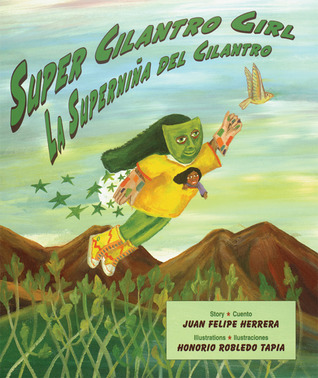
 In general, the “life-changing teacher” is a common character in Latina/o children’s and young adult literature. Herrera’s own The Upside Down presents Mrs. Sampson as a character that helps little Juanito settle into his new school and encourages him to sing in front of the class. Ms. Diaz, in Cindy L. Rodriguez’s When Reason Breaks, has an active role in helping the lead protagonists come to terms with their inner struggles. In René Colato Laínez’s Waiting for Papá, Miss Parrales encourages Beto to share his story of being separated from his father because of existing immigration policies. In Luis J. Rodriguez’s América is Her Name, Mr. Aponte teaches América to use poetry as tool for healing. Ms. Abernard, in Isabel Quintero’s Gabi, A Girl in Pieces insists that Gabi keep writing and sharing her poetry. And then you have the characters that serve as a “teacher figure.” The abuelita in Herrera’s Super Cilantro Girl and the abuelita in Gloria Anzaldúa’s Prietita and the Ghost Woman teach their granddaughters about the power and strength of plants, herbs, and nature. The abuelita in Sonia Manzano’s The Revolution of Evelyn Serrano teaches young Evelyn to have pride in her Puerto Rican culture and history. And then there are the adults that serve as mentors like Sonia, the lawyer that the young characters in Gloria Velasquez’s “The Roosevelt High” series often turn to for help.


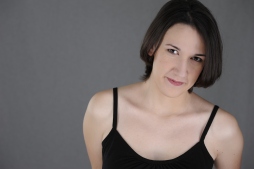 Cecilia Cackley is a performing artist and children’s bookseller based in Washington DC where she creates puppet theater for adults and teaches playwriting and creative drama to children. Her bilingual children’s plays have been produced by GALA Hispanic Theatre and her interests in bilingual education, literacy, and immigrant advocacy all tend to find their way into her theatrical work. You can find more of her work at
  By Sonia Alejandra Rodriguez
 Latinxs in Kid Lit