
.
Reviewed by Sanjuana Rodriguez
DESCRIPTION OF THE BOOK: Roberto Àlvarez loved school. Along with other Mexican American children, he attended the Lemon Grove School, where all students—Mexican American and Anglo—studied together as equals.
In the summer of 1930, the Mexican families learned of a plan to segregate their children in a small, inferior school. Refusing to let this happen, the parents organized. They filed a lawsuit against the school board, with twelve-year-old Roberto as the plaintiff. On March 12, 1931, the judge announced his ruling, supporting the children’s right to equal education. The Mexican American students were immediately reinstated in the Lemon Grove School to learn as equals once again.
With captivating illustrations inspired by vintage citrus crate labels, Christy Hale brings to life the little-known story of the first successful school desegregation case in the United States. It stands as an empowering case in the United States. It stands as an empowering testament to an immigrant community and its tenacity in the fight for educational equity.

MY TWO CENTS: I first learned about this case when I was a PhD student at Georgia State University in a sociology of education course. I remember feeling cheated when I realized that I had not learned about this important piece of American history. This book details the story of the first school desegregation case in the U.S. and does so in a way that children can understand the injustice that the families faced and the courage that it took to challenge school segregation.
The book begins by telling the reader about Roberto Álvarez, a Mexican American 12 year old who attends school in Lemon Grove. Roberto and all the other Mexican children attended the same school as the White children. During the summer of 1930, the families learned that a new school was being built for the Mexican students. When the students returned to school in January of 1931, the principal did not allow the students to enter the school and told them “move aside and let the Anglo students go to class… You do not belong here” (n.p.).
The parents organized. They met with the Mexican consul who believed that “the new school was just a pretext to segregate all the Mexican American children and give them an inferior education” (n.p). The parents filed a lawsuit against the school board and began to raise money for the legal expenses. Roberto Álvarez was named as the plaintiff in the case of Roberto Álvarez v. the Boards of Trustees of Lemon Grove School District. Roberto testified in court and the judge ruled that the school district could not separate all the Mexican American students. All of the students returned to their school the following Monday.
The illustrations in this book are colorful, bold, and bright. One of the features that I noticed in the illustrations was the beautiful way in which the author/illustrator included details such as women’s trenzas, mandiles (aprons), and features of the community in which the children lived. Hale was also able to capture the different emotions that the children experienced. She captured the joy of playing outside and also how scared the children felt as they were being taken to a new school. An author’s note also explains how the illustrations are based on vintage California citrus labels.
One of the obvious characteristics of this book is how it privileges the Spanish translation of the texts. Very few books place the Spanish translation first on the page. The back matter provides extensive detail about the case including what occurred before, during the case, and after. It includes the names of all the children who were included in the court case and gives detailed information about Roberto Ricardo Álvarez, the main character in the story.
This books begins by honoring the “corrido” on which this book is based on: “Un Corrido de Lemon Grove.” A “corrido” is a traditional Mexican story song. This particular corrido details the story of the community in Lemon Grove (details about corridos are included in the back matter). The two pages that feature the corrido grant permission for photocopying. This book could be used a mentor text for students who want to write their own corrido. This is a book that should also be a part of any text set that includes civil rights topics. The case set the stage for Brown v Board and it should be a topic that is introduced to students.
TEACHER RESOURCES: A video titled The Lemon Grove Incident tells about the court case. This was produced by PBS.
Zinn Education Project: Lemon Grove Incident- This page includes a description of the incident as well as a list of teaching resources.
Lee and Low provides a teacher guide for this book.
Lee and Low Blog Post- “How One Teacher Used Todos Iguales to Inspire Social Justice”
.
.

ABOUT THE AUTHOR-ILLUSTRATOR (from her website): When I was little, I knew I shouldn’t make marks in books, so instead, I drew on tiny pieces of paper and tucked my “illustrations” alongside the words. At age ten, I decided to become a writer and illustrator. Back then, my best friend and I acted out the books we loved. Our favorite was Harriet the Spy. Dressed in disguises, we roamed the neighborhood investigating and jotting down our observations in our secret notebooks, just like Harriet. Back at spy headquarters we shared our discoveries with each other. Soon we began writing and illustrating our own stories every day after school.
I have created books as long as I can remember. I studied calligraphy, bookbinding, letterpress and all other means of printing, typography, design, and illustration.
After earning a B.A. in Fine Arts and a Masters in Teaching at Lewis & Clark College in Portland, Oregon, I worked as an art educator for several years. Then I decided to pursue my childhood dream by relocating to Brooklyn, New York to study design and illustration at Pratt Institute.
I taught at the New York Center for Book Arts and as an adjunct professor in the Communication Design department at Pratt Institute while working in children’s book publishing as a designer and art director. During this period, I also began illustrating and have since worked on over 30 books—writing some of those too.
After many years in New York, I moved to Northern California where I continue to work as a writer, illustrator, designer, art director, and as an educator—offering programs at museums, schools, and libraries. I teach an online course in Writing for Picture Books through the illustration department at the Academy of Art University in San Francisco.
.
.

ABOUT THE REVIEWER: Sanjuana C. Rodriguez is an Assistant Professor of Literacy and Reading Education in the Elementary and Early Childhood Department at Kennesaw State University. Her research interests include the early literacy development of culturally and linguistically diverse students, early writing development, literacy development of students who are emergent bilinguals, and Latinx children’s literature. She has published in journals such as Journal of Language and Literacy Education, Language Arts, and Language Arts Journal of Michigan.
 ABOUT THE AUTHOR: Frederick Luis Aldama is Irish-Guatemalan and Mexican Latinx. His mamá was a bilingual elementary school teacher in California. As a kid, he couldn’t get enough of his abuelita’s stories of El Chupacabra, La Llorona, and El Cucuy. Today he is a Distinguished University Professor at The Ohio State University. He is the author, coauthor, editor, and coeditor of 36 books.
 My Papi Has a Motorcycle, written by Isabel Quintero and illustrated by Zeke Peña, tells the story of young Daisy Ramona, a girl who eagerly awaits her Papi’s return home after a long day at work. When he arrives, Daisy Ramona and her Papi will take a ride through their city on the back of his motorcycle. Their ride takes us on a journey through their changing neighborhood, where we get a glimpse into the places and people that make her community so special. On their ride, Daisy and her Papi pass the local panadería where they buy conchas on Sunday mornings, the post office, and their abuelito’s yellow house (where the food always tastes better). They greet each person they meet with a nod of the head or a wave, letting readers see the closeness of this comunidad. Daisy’s ride with her Papi reminds us that although the world outside their home is changing, the love inside will always stay the same.
 Abuelita Full of Life/Llena de vida
 Tía Isa Wants a Car
 In My Family/En mi familia
 The Christmas Gift/El regalo de la navidad
 Imagine
 Planting Stories: The Life of Librarian and Storyteller Pura Belpré
 Separate is Never Equal: Sylvia Mendez and Her Family’s Fight for Desegregation
 Tracey T. Flores is an assistant professor of language and literacy in the Department of Curriculum and Instruction at the University of Texas at Austin. She is a former English Language Development (ELD) and English language arts teacher, working for eight years in K-8 schools throughout Glendale and Phoenix, Arizona. Tracey is the founder of Somos Escritoras/We Are Writers (
 ABOUT THE AUTHOR (from the book):
  ABOUT THE REVIEWER: Dora M. Guzmán is a bilingual reading specialist for grades K-5 and also teaches undergraduate and graduate courses in Children’s Literature and Teaching Beginning Literacy. She is also a current doctoral student in NLU’s EDD Teaching and Learning Program with an emphasis on Reading, Language, and Literacy. When she is not sharing her love of reading with her students, you can find her in the nearest library, bookstore, or online, finding more great reads to add to her never-ending “to read” pile!
 ABOUT THE AUTHOR: R
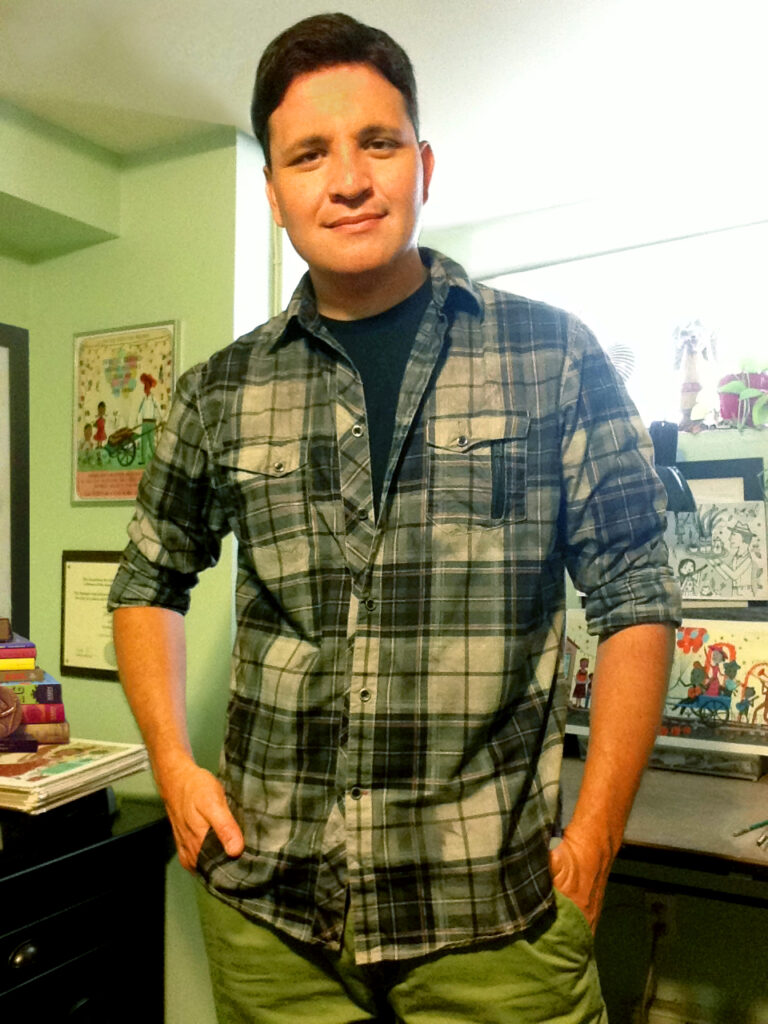 ABOUT THE ILLUSTRATOR: John Parra is an award-winning illustrator, designer, teacher, and fine art painter whose work is avidly collected. John’s books have received starred reviews and have appeared on the Texas Library Association’s 2×2 Reading List. He has received the SCBWI Golden Kite Award for Illustration, the International Latino Book Award for Best Children’s Book Illustrations, and a Pura Belpré Illustrator Honor for Gracias/Thanks, written by Pat Mora. Find out more about him on his website
  DESCRIPTION OF THE BOOK: Young René’s mother has sent him a new pair of shoes from the United States. He loves his new shoes. “They walk everywhere I walk. They jump every time I jump. They run as fast as me. We always cross the finish line at the same time.”
 ABOUT THE AUTHOR (from his
  Latinxs in Kid Lit